Top-coat
Helps repel water, resist oil and staining, and self-heal light surface scratches with heat.
Color-change TPU film combines a color layer with the protection of PPF, and installs wet or dry thanks to its honeycomb air-release structure.
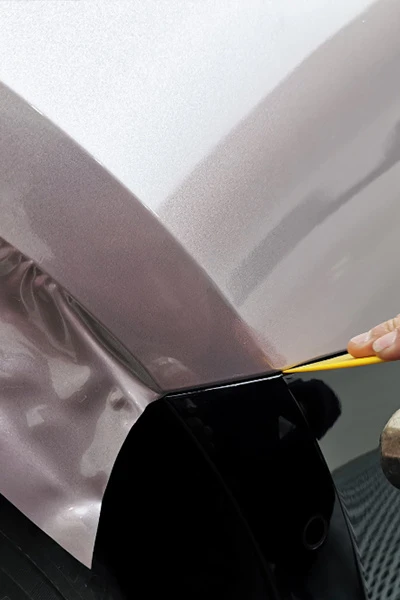
Solution 04 · Color TPU PPF
Unlike traditional PVC wrap, which leans towards color, color-change TPU PPF combines a polymer color layer with an elastic TPU substrate and a functional top-coat. According to VEGO’s documents, the air-release structure supports wet or dry installation, while the outer coating repels water, resists staining and self-heals light scratches with heat.
Choosing the right material
| Criteria | Color-change TPU PPF | Traditional PVC vinyl |
|---|---|---|
| Main purpose | Color + surface protection | Color change / graphics |
| Base material | Elastic TPU | PVC |
| Light swirl marks | Top-coat can support self-healing with heat | Depends on each product’s coating |
| Thickness | Usually thicker to absorb impact | Usually thinner, easy to shape for graphics |
| Application | Cars needing personalization and paint protection | Short- to medium-term color change, advertising, complex parts |
This table describes differences at material-group level; specific specifications must be checked per SKU.
Functional construction
Helps repel water, resist oil and staining, and self-heal light surface scratches with heat.
Creates the shade and finish effect. The actual color varies with light, base paint and the shape of the car body.
Provides stretch, durability and better impact absorption than a standard decorative wrap base.
Helps air escape during alignment, reduces bubbles and allows an installation process suited to the product.
Design before you wrap
Gloss brings out depth; Satin balances reflection; Matte emphasizes form but needs more careful stain care.
Folded edges, door gaps and uncovered areas may show the original color; agree the coverage from the start.
The roof, mirrors, lip or trim can use another color, but the whole must be managed to avoid a disjointed look.
Keep the color code and material batch; replacing a panel after a long time may show a slight difference.
Company vehicles need colors, logos and graphic positions approved before the material is cut.
The initial paint condition and any repainted panels must be recorded before installation.
Full-car installation
Record scratches, repainted panels, ceramic coatings and parts at risk of lifting during disassembly.
View samples in the sun and indoors; agree the panels, folded edges and parts to be removed.
Remove dirt, tar and oil; treat the surface as the adhesive system requires.
Control the pulling force so color, gloss and thickness do not distort on curves.
Fold edges where permitted, avoid overstretching and ensure air can escape along recesses.
Check the color, edges, bubbles and pull marks, and activate the correct SKU on the warranty card.
FAQ
The TPU substrate absorbs small impacts better than a thin decorative wrap, but it cannot protect against every impact.
VEGO’s documents describe both methods, thanks to the air-release structure. The final technique must follow the instructions for each SKU.
No. Screens, lighting, viewing angle and base paint color all affect how it looks; you should see a real material sample.
The film cannot repair paint that has already deteriorated. With stable paint and correct removal, the aim is to preserve the original surface underneath.
The VEGO team can advise you on film lines, dealer terms and technical support.
Call 0924 802 802Send a request