Decorative technology keeps developing, and film products are becoming ever more diverse. Glass window film is one of them, welcomed by consumers for its excellent properties and good quality. So what exactly is window film? This article will help you understand it better.
Introduction to window film and its types
Glass window film is a multi-functional polyester composite film material. Applied to the surface of architectural glass, it improves the performance and durability of the glass, increases its bending strength and impact strength, prevents injuries from falling broken glass, and also provides protection and burglary resistance.
In recent years, window film has grown quickly in China’s automotive and construction industries. For small cars in particular, 90% of owners choose to fit film.
Types by field of application
By field of application, window film today falls broadly into three types: architectural glass film, automotive glass film and safety glass film.
Architectural glass film
Its main purpose is energy saving and heat insulation, along with safety and UV protection functions. This group includes heat-reflective film and low-emissivity film.
Heat-reflective film lets visible light and near infrared into the room but does not let far infrared pass through. The room therefore stays bright enough, most of the sun’s heat is reflected back, and the indoor temperature does not rise too much in the hot summer months. The load on the air conditioning falls, and air conditioning and energy costs fall with it.
Low-emissivity film lets a certain amount of short-wave solar radiation pass through, so heat enters the room and is absorbed by the objects inside. At the same time, the film keeps more than 90% of the long-wave infrared radiation from those objects in the room. It makes full use of solar radiation and indoor long-wave energy, so it can be used in cold regions and heated buildings for heat insulation and energy saving.
Automotive glass film
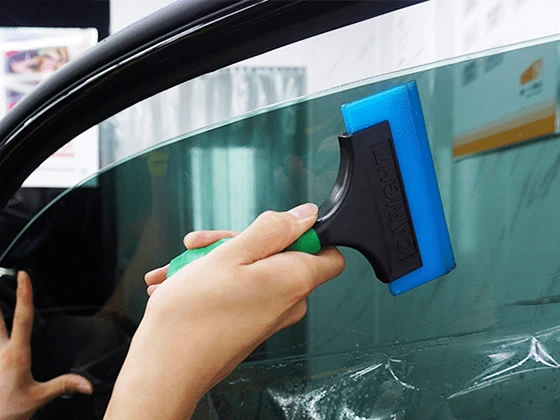
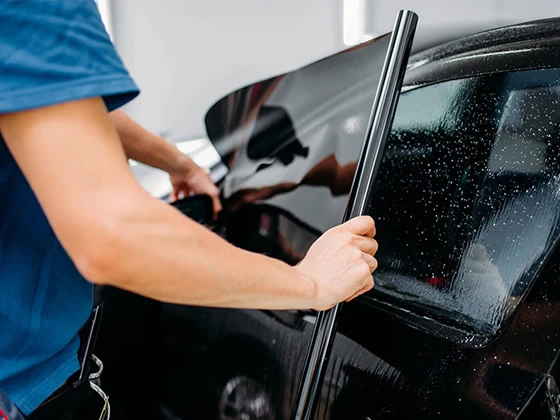
This film is applied to the inner surface of car glass. It provides heat insulation, energy saving, UV blocking, security and burglary resistance. The requirements for its visible light transmission and reflectance are also very high, especially on the windshield.
Under the “Technical Conditions for the Safe Operation of Motor Vehicles”, the visible light transmission of the front windshield must not be less than 70%, and no window glass may be fitted with mirror-reflective sun control film. Film for the windshield must therefore have a visible light transmission above 70% after application to meet national standard GB7258-2004.
Safety glass film
There is a layer of strong adhesive between the film and the glass. The film itself resists tearing and penetration well, so even if the glass breaks it stays in its original overall state, preventing secondary injury to people when glass breaks in an accident.
The film’s main function is shatter-resistant safety. It is commonly used in banks and financial institutions, jewelry shop windows, museums, hotel lobbies, other important premises and exhibition halls. It also offers a degree of heat insulation, UV blocking and high transparency.
Types by production process
In terms of production process, window film is divided into three types: dyed film, base-color film and vacuum-coated film. Dyed film includes standard film, surface-dyed film and interlayer-dyed film. Vacuum coating includes vacuum evaporation coating and magnetron sputtering. By coating material, film is further divided into metal film and ceramic film.
- Standard film (commonly called “tea paper”) is made with dye mixed into adhesive coated on a polyethylene base. This is the oldest production method. The film does not insulate against heat or block UV and has a short service life, so it is rarely used now.
- Surface-dyed film has dye coated on the surface of a PET base. It feels very soft, lacks toughness and shatter resistance, does not withstand UV, fades easily and has a short service life.
- Interlayer-dyed film has dye coated between two PET base layers. It feels very soft and has a certain resistance to UV aging. Because of its cost, this type is still on the market.
Common characteristics of dyed film: low visible light reflectance, a lack of good heat control, easy fading (usually turning purple) and easy blistering after long use.
Base-color film is window film with no added organic dye. To date, optical-grade PET film exists only as gray and colorless polyester film; other colored PET films have to be dyed. Base-color film feels good in the hand, does not fade easily and has a long service life.
Vacuum evaporation coating uses a thermal evaporation process (with pure metals of low melting point) to coat the film with various metals, alloys or oxides. This process usually deposits pure aluminum and can create films with different visible light transmission and reflectance for the best sunlight control.
Vacuum sputter coating takes place in a large vacuum chamber, in an inert gas environment at very low pressure. Under electrical energy, charged ions strike a metal or alloy target, forming multiple dense metal layers with low reflection and high heat insulation, coated evenly and in an orderly way on the surface of the polyester film. The combined process creates a range of distinctive stable colors and high transmission selectivity, ensuring the product has sufficient durability, shatter resistance, heat insulation, 99% UV protection and a long service life.
Ceramic film contains SiO2, TiO2 and other ultra-thin ceramic coatings. It has no metal layer, so it causes no interference at all with GPS satellite navigation, radio communications or mobile phones in the car. The film does not oxidize or fade, is easier to maintain than metal film, and is durable. It has low reflectance and moderate light transmission. Vigu’s amber ceramic film, 3M Crystal automotive window film and the basalt automotive film line from Johnson & Johnson all belong to this product group.
Summary by technology
- Dyed film: accessible cost, geared towards privacy.
- Carbon film: stable color and balanced performance.
- Metalized film: strong heat reflection.
- Nano ceramic film: high heat rejection, good clarity and no signal blocking.
How to choose correctly
Identify the glass position, the visible light transmission you want, your heat rejection needs and the warranty conditions. Measure the actual glass and view samples before deciding.