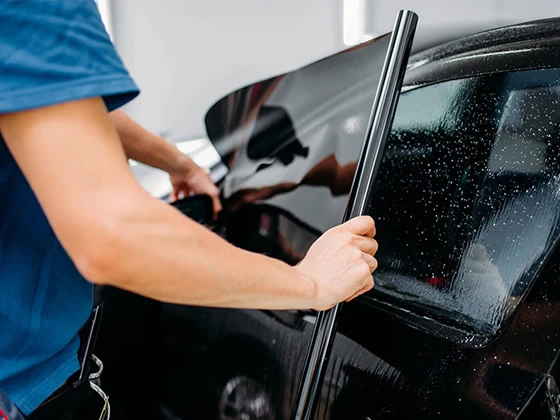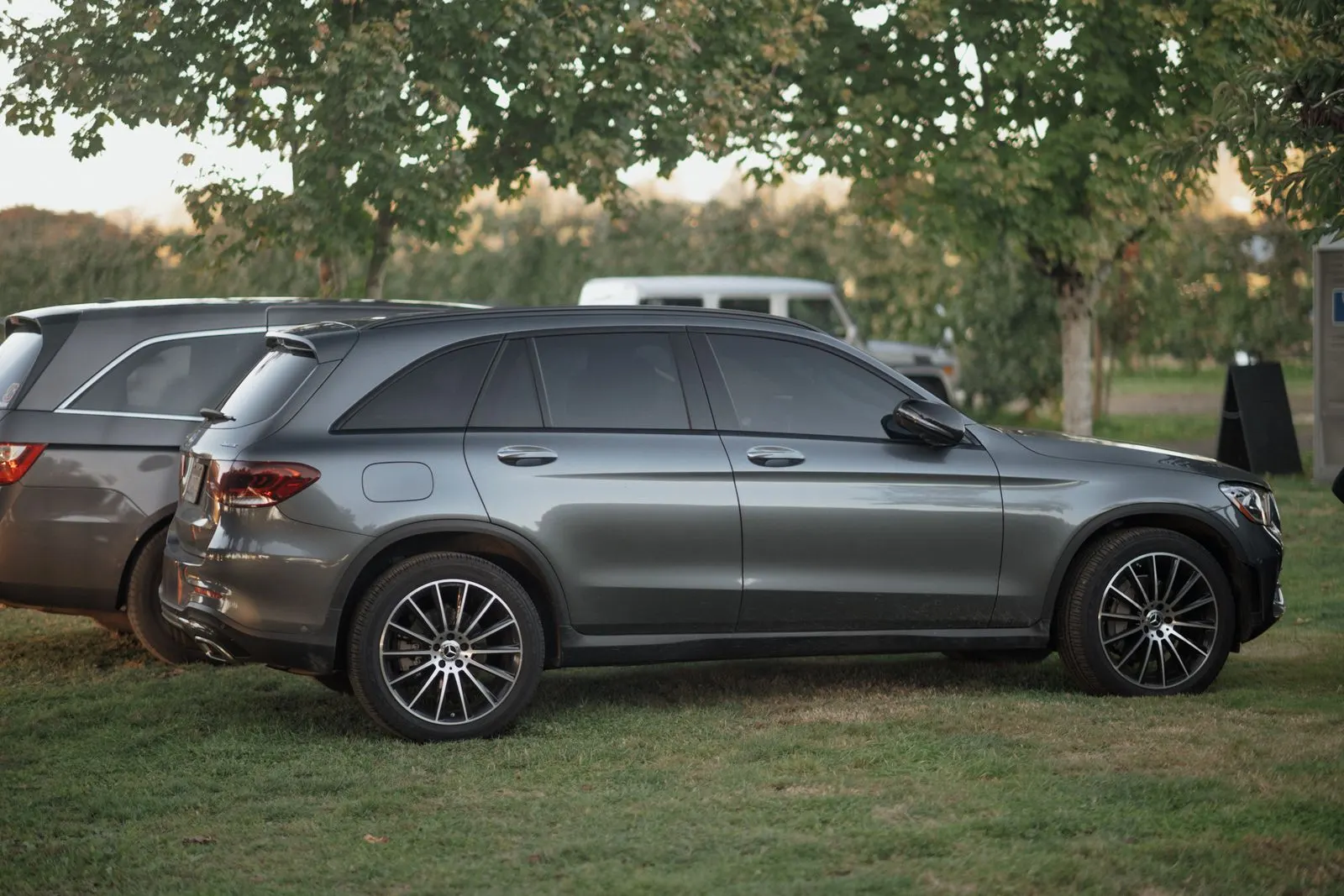
The right window tint percentage differs by position: a visible light transmission (VLT) of 70% or higher on the windshield, about 35 to 50% on the front side windows, 15 to 35% on the rear side windows, and 5 to 20% on the rear window, depending on how much privacy you want. Do not use one number for the whole car. When you are torn, picture reversing in a dark parking garage on a rainy evening, not admiring the car in the midday sun outside the shop.
Film samples are always viewed in the shop's flattering light. In daylight, dark glass looks sharp and very private. Three weeks later, at 9 p.m. on an unlit highway, with oncoming headlights shining straight at you, you finally understand what you bought.
What does the percentage on a film code mean?
VLT is the share of visible light that passes through the film. A 70 film lets through 70% of the light and blocks 30%. The lower the number, the darker the film, which is the opposite of what many people assume when they first read the specs.
What is easy to forget is that this number applies to the film alone. Car glass also blocks some light, so the result after installation is lower. On side windows, many high-riding models come with dark rear glass from the factory; a 20% film laid over glass that is already dark can end up very dark indeed.
A rough estimate is to multiply the two numbers: for example, 80% glass with 50% film gives about 40%. A worked table for the windshield is in our article on window film regulations.
Recommended window tint percentage by position
These are our recommendations, based on a family car driven both day and night.
| Position | Suggested level | The trade-off |
|---|---|---|
| Windshield | 70% or higher | Less cooling than dark film, so it takes good material to compensate |
| Front side windows | 35 to 50% | Lighter makes the mirrors easier to see, but gives less privacy |
| Rear side windows | 15 to 35% | More privacy, but blind spots are harder to check when turning around |
| Rear window | 5 to 20% | Darker film makes the interior rearview mirror harder to use at night |
| Sunroof | Depends on the glass | Ask first, because roof glass is often already dark |
Of these, the gap between the front side windows and the rear window is what decides the look. Too wide a gap looks like two cars stitched together. Many owners choose two levels, lighter in front and darker in back, which also works if the step between them is moderate. Try a sample on the actual glass before you decide.
Why does dark film make the windshield glare more at night?
It sounds backward. Shouldn't dark glass reduce glare?
At night, your pupils open wide to gather enough light from the road surface. Dark film makes the road look darker, so your eyes open even further. A pair of headlights coming at you then creates a very harsh contrast between the bright point and the dark background. Dust on the glass or scratches on the film will make that light flare. This is reasoning from how vision works; we do not have a measurement for each film code.
So there is an easy rule to remember: the older you are and the more you drive at night, the lighter you should go. A review of older drivers notes that drivers over 65 report more glare from oncoming headlights, recover from glare more slowly, and read road signs less well at night. If your parents also drive this car, do not choose film by your own eyes.
Rain is the same. Wet glass, reflected streetlights, plus dark film. It is the same windshield, but a completely different test from a sunny noon.
Choose by the way you drive
The table above is only a starting point. Below are three common setups, using codes from the VEGO catalog as illustrations. Which code suits your car still depends on the original glass.
Family car, driven day and night, safety first. Windshield VP7095HD (70%, 8-year warranty). Front side windows IR5090 (50%, 8 years). Rear side windows and rear window VN20HD or VP2095 (20%). VN20HD has a 5-year warranty and VP2095 an 8-year warranty, so ask carefully when comparing prices.
Commercial car, long trips, passenger pickup and drop-off. Windshield T70 or VP7095HD. Front side windows T35. Rear T15 or IR1590. Passengers in the back usually value privacy, while the driver needs a clear view of the mirrors through the front side windows.
City car, parked in a garage, moderate budget. One line for the whole car, for example VEGO STANDARD (T Series): T70, T35, T15 or T05. The 5-year warranty is enough for many people who do not keep a car very long.
If you want high VLT with strong heat rejection, compare TSER between codes at the same VLT rather than dropping the VLT. How to compare is covered in our article on film specifications. See all the lines in the product catalog.
Does light film still block UV on side windows?
There is one reason to feel comfortable going lighter. The UV blocking of a quality film does not depend much on how dark it is, so you do not need black film to stop UV. For the actual figure, check the spec sheet of the exact code.
This matters because side windows are considerably weaker than the windshield. A study of 34 cars measured the driver's side window blocking an average of 88.78% of UVA, with a low of 65.22%, while the windshield blocked 99.25%. The study was done in the US and the number of cars is small, but the direction is clear. If you drive long distances with your arm in the sun through the side window all afternoon, the front side windows deserve good film, even if you choose 50% to keep the mirrors easy to see.
This is where many people save money in the wrong place. They put their budget into the windshield and choose a cheap film for the two front side windows, even though that is where the sun falls directly on the driver the longest.
What if the car already has dark glass?
Many high-riding cars have dark rear side windows and rear windows from the factory. Installers call this privacy glass. Add a 15% film to this glass and the result can be much darker than the same film on clear glass.
In this case, many owners choose a lighter film for the rear to keep the color even with the front, adding heat rejection rather than more darkness. On the other hand, the front glass of those cars is usually clear, so going too dark there turns the car upside down: dark in front, darker still in back, and a cabin like a cave.
Before choosing, sit in the car and look through the rear glass at dusk. The original privacy glass already shows you what that level of darkness looks like, and from there you can decide whether you need more.
When should you avoid dark film?
Not everyone should "go black for full coverage."
New drivers who are not yet used to reversing by mirror. Front side window film that is too dark makes the side mirrors harder to read at night, because you are viewing them through the film.
Cars with no reversing camera. A 5% rear window with 5% rear side windows leaves night reversing almost entirely dependent on the mirrors.
Cars driven in foggy areas. Fog plus dark film sharply reduces visibility; the mountains of northern Vietnam in winter are an example.
For cars carrying older people or light-sensitive passengers, it is the other way around: they may prefer darker film in the back because there is less glare, so ask them first.
The most common mistake is choosing by someone else's car. The same 15% film gives two very different results on a high-riding car with dark rear glass and on a sedan with clear glass.
Test before you commit
Ask the shop to put a sample on your car's glass, and do not judge from a display pane. Sit in the driver's seat and look through both the film and the mirrors. If you can, try it in the early evening or in a parking garage.
After installation, ask the shop to measure the actual VLT of each window and write it down. A decent shop will not mind being asked. The real figures help at both your next vehicle inspection and your next film change.
The general criteria are in our article on choosing window film, and the technology is covered under automotive window film solutions.
What to do before you book
Note down how you drive: how much of it is at night, whether you have a reversing camera, whether you carry children or older people. Send that with your car model through the contact page or call 0924.802.802 to get a setup for each window.