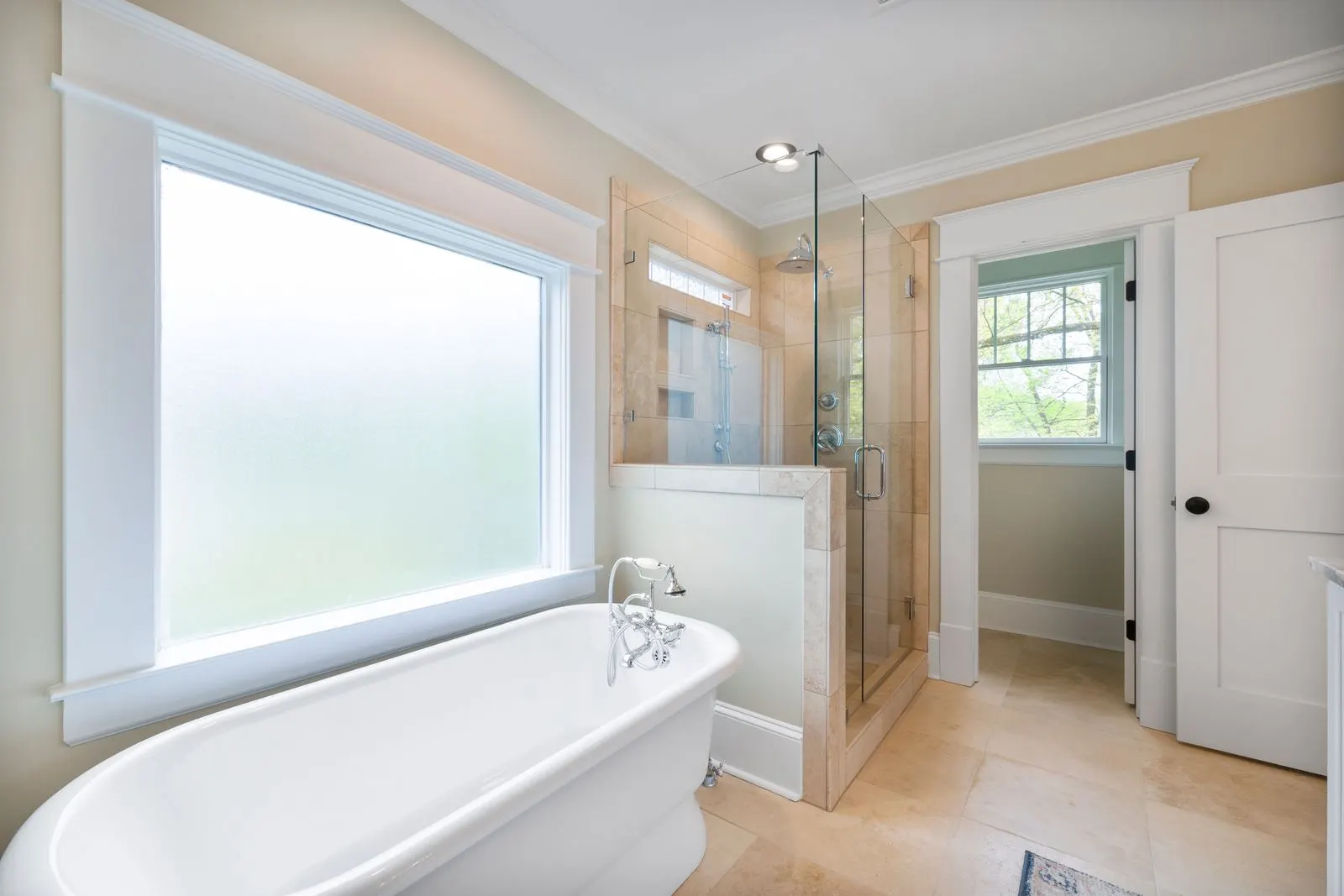
What is SHGC? It is the solar heat gain coefficient, a number from 0 to 1 that tells you how much of the sun's energy gets in through a window. The lower the number, the less heat enters the house. The building glass industry uses SHGC, the car tint industry is used to TSER, and the two numbers are directly linked. The easy mistake: the SHGC on a label is often for the whole window, frame and glass together, not the glass alone.
People building a house or fitting out an office usually meet SHGC for the first time on a quote for aluminum and glass windows, wedged between U-factor and VT, with nobody explaining it. Meanwhile the film shop talks only about TSER and IRR. The two sides speak different languages, and the homeowner is stuck in the middle.
What is SHGC, and how do you read the number?
SHGC stands for Solar Heat Gain Coefficient. It is the share of solar radiation that actually enters a building through the whole window, including what passes straight through and what is absorbed and then radiated inward. The scale runs from 0 to 1. According to the Efficient Windows Collaborative guide, the lower the SHGC, the less solar heat the film lets through.
So an SHGC of 0.35 means about 35% of the solar energy reaching the window gets inside. Watch the direction of the number: a low SHGC means good rejection, a high TSER means good rejection. The two run in opposite directions, and this is where beginners often misread.
Why does home glass use SHGC instead of TSER? Because in construction, a window is part of the building and is counted in the heat calculation for the whole structure, so you need a coefficient that works for the frame, sash and glass together. The NFRC label for windows has three main numbers: U-factor, SHGC and VT. Car film only changes the glass, and it is sold by the film's spec sheet, so that industry got used to TSER.
How are TSER and SHGC related?
The usual formula is TSER = (1 − SHGC) × 100%. Apply it to the numbers on one international brand's spec sheets and you can work back to SHGC. This is our calculation, not a figure the manufacturer publishes, and it uses spec sheets measured on 6 mm clear glass.
| Film | VLT | TSER on spec sheet | Derived SHGC | Derived LSG |
|---|---|---|---|---|
| Dark film | 19% | 65% | 0.35 | 0.54 |
| Medium film | 29% | 62% | 0.38 | 0.76 |
| Light film | 77% | 44% | 0.56 | 1.38 |
The LSG column is explained in a later section. All three are automotive films, taken from two different documents, and are here to show how the conversion works. Films for home glass have their own spec sheets and their own test conditions.
The conversion only holds when both numbers describe the same thing. If the SHGC is for the whole window and the TSER is for film on a single pane, subtracting one from the other is wrong.
How do SHGC, g-value, SC, U-factor and VT differ?
Five names, three kinds of information. The table below sums them up for quick reference.
| Metric | What it covers | Good value when you want it cooler |
|---|---|---|
| SHGC | Solar heat coming in through the window | Low |
| g-value | Roughly equivalent to SHGC, used in Europe | Low |
| SC | Older shading metric | Low |
| U-factor | Heat transfer not caused by the sun | Low |
| VT | Light coming through, weighted by eye sensitivity | Depends on how much light you want |
g-value is in practice almost the same thing as SHGC, with small differences in the calculation standard. If a European document says g = 0.4, read it as SHGC 0.4 and you're fine.
SC, shading coefficient, is an older metric measured against a reference sheet of clear glass. Older documents still use it. You can convert roughly with SHGC ≈ SC × 0.87, so SC 0.5 corresponds to an SHGC of about 0.44. That is only an approximate conversion, not something to use for close comparisons down to the percent.
U-factor measures heat moving through the window because of the temperature difference between inside and outside, and has nothing to do with sunlight. This is where a lot of sales pitches get muddled. According to the guide mentioned above, window film does not give a meaningful insulation benefit. In other words, film mainly blocks incoming sun, it does not turn glass into a wall. In Vietnam, window film is commonly sold under a name that literally means "heat insulation film"; that is just the market's familiar name, so don't let it fool you.
VT, or VLT in the car world, is weighted by the sensitivity of the human eye. So it does not measure energy, it measures the brightness you perceive.
How to calculate LSG: one very useful division
LSG, light to solar gain, is VT divided by SHGC. The higher the ratio, the more light the glass lets in for each unit of heat.
A pure numbers example: glass with VT 0.6 and SHGC 0.3 has LSG = 0.6 ÷ 0.3 = 2. A second glass with VT 0.3 and SHGC 0.3 blocks exactly as much heat, but its LSG is only 1: the room is half as bright and not one bit cooler.
This is the angle many comparison tables miss. If you only look at SHGC, dark film always wins, because darkness is the cheapest way to lower SHGC. Look at the first table: the 19% VLT film has a much lower derived SHGC, but a derived LSG of only 0.54, while the 77% VLT film has a higher SHGC and a derived LSG of 1.38. The dark film gets its low SHGC by sacrificing light. The light film does most of the heat-blocking job and keeps the light.
In a home, that has real consequences. Tint the living room too dark and you have to turn the lights on during the day, the people living there are uncomfortable, and you lose the view out. So when choosing film for a home, we think SHGC and LSG should be read together: first set an acceptable VT for the room, then look for a low SHGC within that group. It is the same idea as the car rule of comparing TSER at the same VLT.
Is the number for the whole window or just the glass?
This is the most valuable question in the whole article.
The frame and sash don't let light through, and they also behave differently from glass thermally. So for the same glass, the whole-window number differs from the center-of-glass number. A table in an energy textbook shows this clearly:
| Window type | Whole-window SHGC | Center-of-glass SHGC | Whole-window VT | Center-of-glass VT |
|---|---|---|---|---|
| Single pane, clear | 0.79 | 0.86 | 0.69 | 0.90 |
| Double pane, clear | 0.58 | 0.76 | 0.57 | 0.81 |
For the double pane in the table, the center-of-glass SHGC is 0.18 higher than the whole-window figure. If one quote uses the center-of-glass number and another uses the whole-window number, the comparison can be off by enough to flip the conclusion. The same product can show an LSG of 0.98 or 1.07 depending on how it is calculated.
A film spec sheet usually gives numbers for the film and glass system, without the frame. The NFRC label on a window is a whole-window number. So before you compare, ask exactly one question: is this number for the whole window or just the glass?
Using SHGC to choose film for your home
Solar control film suits climates where cooling is the priority. Film lowers SHGC by reflecting and absorbing. The absorbed part heats the glass, and that is the downside.
With double glazing, thick annealed glass and tinted glass, there is a risk of cracking from thermal stress or seal failure, so it has to be assessed before film goes on. A glass manufacturer's technical bulletin also says that film on the room-side surface of double glazing mainly cuts glare and reduces very little heat. In other words, the film's SHGC on paper does not automatically turn into results on your double glazing. These risks are covered in our article on window film for west-facing windows.
When should you not spend money on SHGC? On windows that get little direct sun, or windows already shaded by a deep overhang or trees. There the solar heat is small to begin with, and a low-SHGC film just makes the room darker. We also don't quote any electricity savings figure, because the result depends on each building and there is no independent source we could find for conditions here.
If you are comparing car films, our overview of window film specifications uses the numbers the car industry is more familiar with.
Next steps
List the windows that face harsh sun, note the glass type if you know it, then look at the options on the architectural window film solutions page. If you need to compare two quotes whose SHGC figures were calculated differently, send them to VEGO through the contact page.