Home window film types fall into five groups by what they do: solar control film to cut sun, frosted film for privacy, reflective film so you can see out but others struggle to see in during the day, safety film to hold broken glass, and decals for decoration. Pick the wrong group and no film, however good, will solve your problem.
A typical Vietnamese townhouse runs into all five. A hot west-facing window, a bathroom window that looks onto the neighbors, a living room right on the street, a big glass door with kids running past, a shopfront that needs the store name on it. Putting one type of film on the whole house is the fastest way to solve one problem and miss four.
This article goes through each type and covers what it cannot do too. That part usually gets left out of quotes.
Home window film types compared
The table below gives a quick view. Each group contains many different products, so this is a general description.
| Type | Does | Does not | Suits | Avoid |
|---|---|---|---|---|
| Solar control film | Cuts sun, glare, UV | Insulate significantly | Sun-facing glass | Installing before you know the glass type |
| Frosted film | Privacy day and night | Keep the view out | Bathrooms, meeting rooms | Rooms with a view you want |
| Reflective film | Daytime privacy, reflects sun | Privacy at night | Glass in strong sun | Shopfronts, apartments |
| Safety film | Holds broken glass | Stop glass breaking | Doors, floor-length glass | Treating it as a structural substitute |
| Decals | Decoration, branding | Block sun | Shopfronts, glass partitions | Sun-facing glass, large solid patches |
This is a relative assessment compiled from industry documents. Individual products vary in quality, and the table does not rank any brand.
One thing the table cannot say, and this is our own view: every film trades one thing for another. Dark solar control film trades light for less sun. Frosted film trades view for privacy. Reflective film trades the look of the glass for reflection. Thick safety film trades money for a level of safety you hope you never need. Asking "what does this film trade away?" is more useful than asking "is this film good?".
Solar control film
This is the group most people have in mind. According to the Efficient Windows Collaborative, this kind of film reduces solar heat by reflecting and absorbing it, blocks most UV, and suits climates that mostly need cooling.
What it does: less burning sun near the glass, less glare, less fading of furnishings. Keep in mind UV is not the only cause of fading; light and heat play a part too.
What it does not do: insulate significantly. The same source says so plainly. If the room is still stuffy at night, film is not the answer. On the inside face of double glazing, according to Pilkington's bulletin, the effect is mainly glare reduction.
The risk is that film absorbs heat and warms the glass. With ordinary annealed glass and glass with shadows on it, that can cause cracking. See our article on film for west-facing windows for details. To compare two films, use how to read the specs: at the same light level compare TSER, or for house glass, SHGC.
Frosted film for privacy
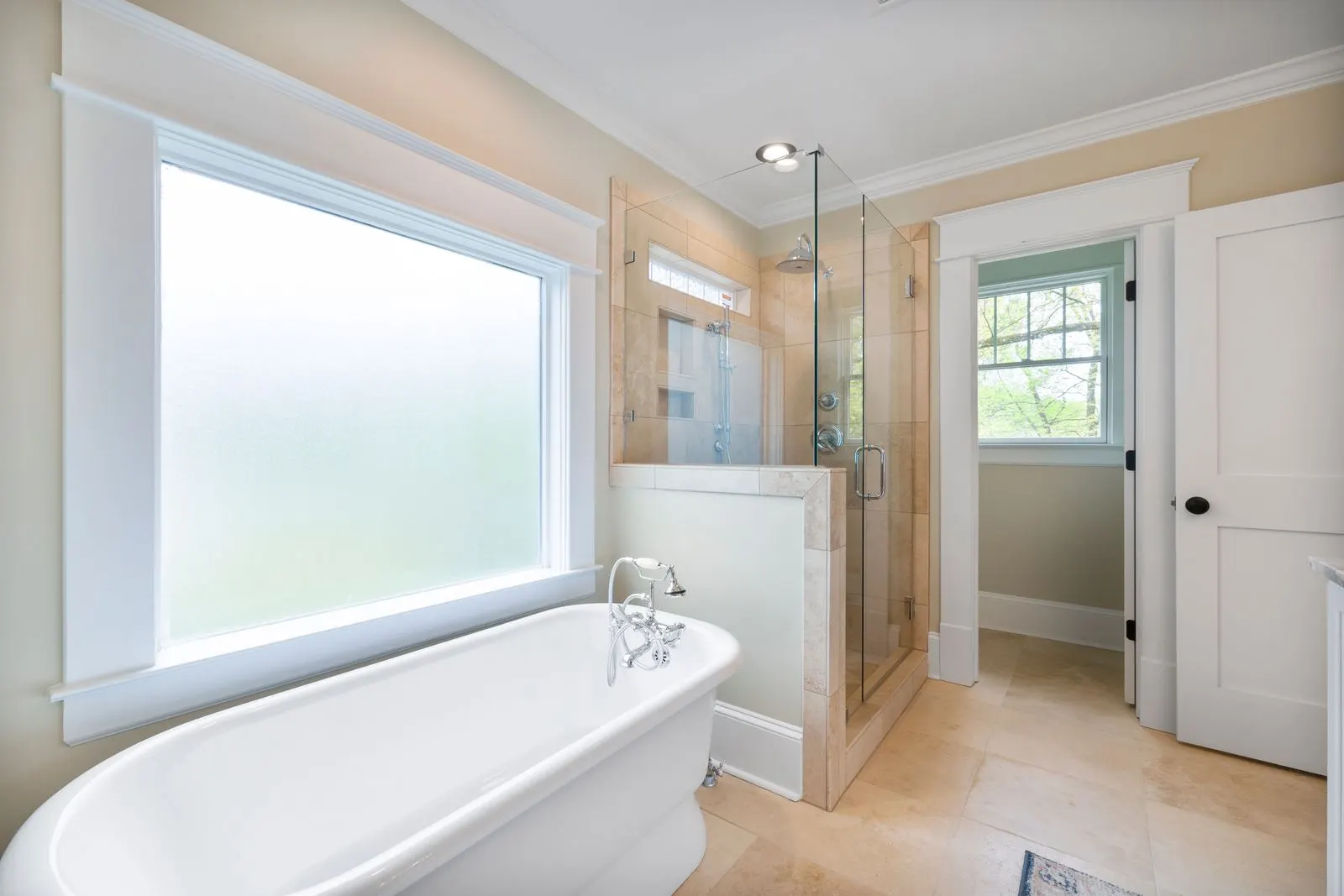
Frosted film turns the glass opaque like sandblasted glass. Light still comes in, images do not. The effect does not depend on which side is brighter, so this type gives privacy both day and night.
What it does: bathrooms, windows close to the neighbors, meeting room glass, the lower part of a street-facing window. You can apply a horizontal band at eye level and leave the top clear for light and a view of the sky.
What it does not do: let you see out. And it is not a heat control film either. Sales documents say frosted film rejects less heat than reflective film. If you need both, ask about a combined product, or put frosted film on the lower part and solar control film on the upper part.
In bathrooms, adhesive frosted film usually makes more sense than static cling, because static cling tends to peel in damp places. This comes from one film seller's documents, so ask about the exact product you plan to buy.
Reflective film, also called one-way film
This film has a reflective layer, and from the brighter side it looks like a mirror. In the daytime it is brighter outside than inside, so people outside see a mirror and people inside can see out. At night, with the indoor lights on, it flips and people outside can see in quite clearly.
What it does: daytime privacy, reflects some of the sun. What it does not do: privacy at night. "One-way" in the ads is only true for half the day, and there is a separate article that covers this in depth.
The big trade-off with this group is appearance. Mirror-like glass changes the facade of the house. For a shop, it also hides the goods during the day. In an apartment building, ask building management first. Light reflected off the glass can also shine into the house opposite.
Safety film
This is thick PET film that keeps fragments stuck together when the glass breaks. According to the overview of safety and security film, thickness ranges from about 100 to more than 525 µm, and performance depends on the adhesive, thickness, installation and frame. On the market you often see 4 mil and 8 mil.
What it does: reduces the risk of flying glass, especially for doors, floor-length glass and homes with small children. Broken glass clings to the film instead of flying out in loose shards.
What it does not do: make glass unbreakable, or replace railings and structure. If you want the whole broken pane to stay in the frame, you need frame anchoring, and for high-rise buildings, ask an engineer.
Choosing safety film by thickness alone is not enough. A thick film that does not reach the edges and is not anchored can still let the whole pane fall out of the frame when the glass breaks.
Decals and decorative film
Decals are the group for showing images: store names, logos, patterned bands, markings so people do not walk into clear glass doors. At heart it is a decorative material, not made to block heat.
What it does: branding, looks, partial privacy, marking glass. What it does not do: cut sun significantly, unless you use a product that is stated to have that function.
One point that often gets overlooked. A large dark patch on sun-facing glass makes the glass heat unevenly between the part with the decal and the part without. In theory, that is exactly the kind of uneven heating that causes thermal stress. This is our inference from the mechanism, not a case recorded in the documents we read, but it is reason enough to ask first with ordinary annealed glass.
Which type first?
Three questions, in this order, are usually enough to narrow it down.
What is the main problem of this pane? Heat, being seen, or fear of breakage. Each pane gets its own answer, not one answer per house.
What kind of glass is it? Annealed, tempered, double glazing, coated or not. The answer can rule out some films before you even talk about price.
How will you live with it? Can you accept a slightly darker room, can you use curtains at night, are there restrictions on the outside of the building?
The real-world survey process is on the architectural film page. For positions inside the home, there will be a separate article on choosing room by room.
Next step
List each pane with its problem, for example hot west window, bathroom window people can see into, and send it to the VEGO team through the contact page for a suggestion on the right film group.