Before you reach for skylight window film, block the sun on the outside of the glass, give the hot air a way out, and only then think about film. Film on the inside is a sensible option for some glass types, but it holds heat right in the pane sitting over your head, so you need to know exactly what glass it is before applying anything. On a plastic dome, standard film is close to useless.
Noon, a three-story tube house. The staircase under the light well is lit up like a stage, the handrail is warm, and the top floor is stifling while the ground floor stays comfortable. The owner calls an installer, who says a dark film will sort it. Sometimes that is true. But this is the fussiest piece of glass in the house, and a rushed decision costs more here than at a window.
Why does a glass roof get hotter than a vertical window?
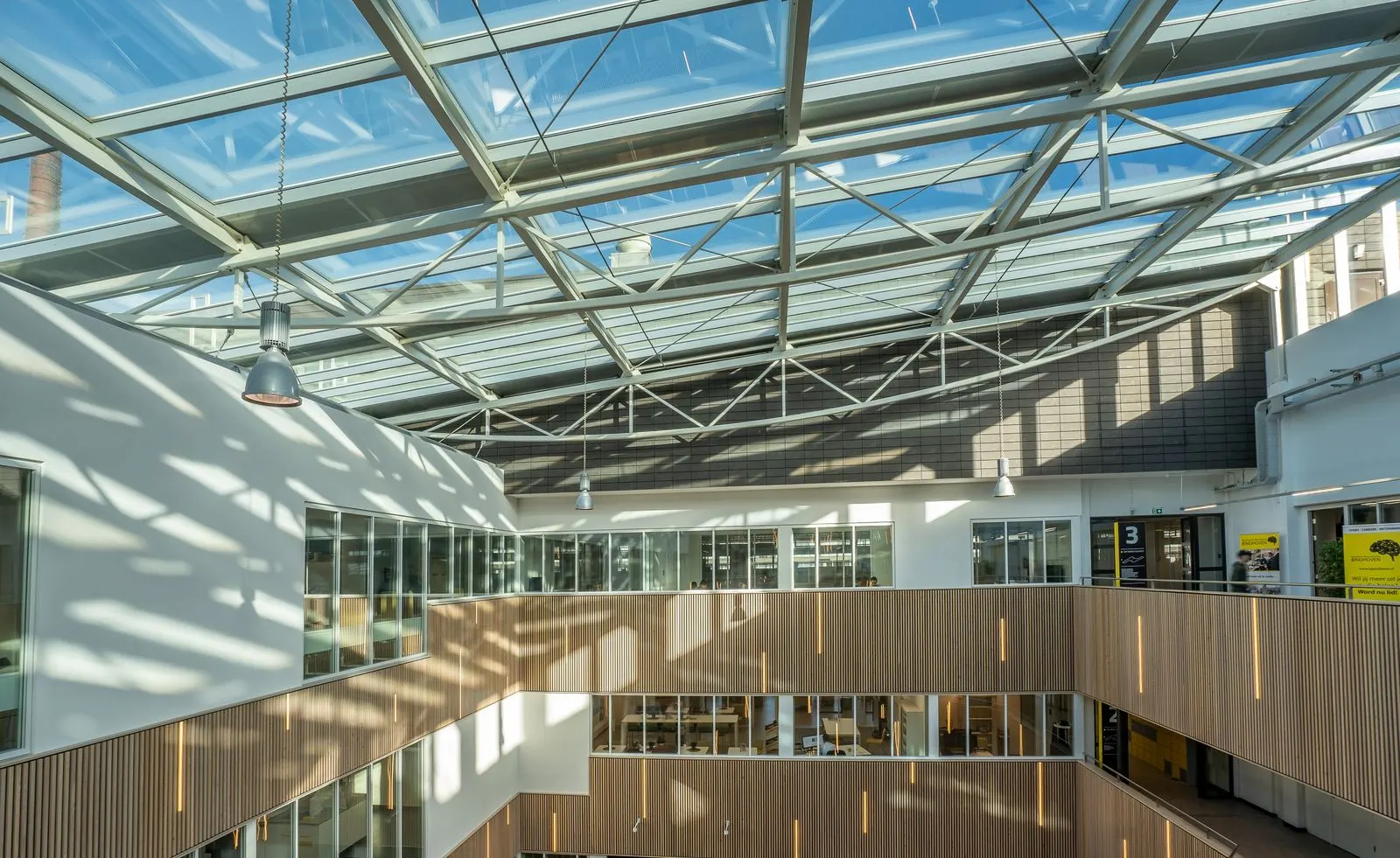
The sun angle is the first reason. At midday the sun is high, so its rays only graze vertical windows, which are often partly shaded by an overhang or balcony anyway. A glass roof is the opposite: midday sun hits it almost square on, with nothing above to block it. Vietnam sits in the tropics, so in the hot season there are days when the sun is nearly straight overhead.
A technical article on roof glazing also notes that sloped glass usually runs hotter than vertical glass, because the sun strikes it nearly perpendicular and warm air collects on the inside of the pane.
The second reason is the shape of the light well itself. Hot air rises, meets a sealed glass lid and stops there. The glass is taking the sun and sitting right where the hot air piles up. In a tube house, the well is built for light and ventilation, but once the top is sealed it only does the light, plus a pocket of hot air on the top floor.
Those two reasons show why film alone struggles to fix everything. Film acts on the sun passing through the glass. It cannot do anything about the pocket of hot air already trapped at the top of the well.
Why not rush film onto this glass?
If a window cracks, you have one broken pane. If a glass roof cracks, the pieces have a straight drop through the open stairwell.
North American design literature is clear about this: sloped glass is more likely than vertical glass to fall out of its frame when it breaks, and laminated safety glass is usually recommended for single panes or the inner pane of double glazing. That is practice elsewhere, which we mention to explain the logic. For your building, ask an engineer and check current local regulations.
There is also thermal risk. A pane with both a sunlit zone and a shaded zone expands unevenly, which creates stress. Shadows from glazing bars, steel beams, trees or the house next door sweep across the glass every day. Solar control film absorbs extra heat on top of that, making the glass hotter. The European Window Film Association puts ordinary annealed glass in the group that always needs a compatibility assessment, and concludes the risk can be kept low but never zero.
This is our view, drawn from those documents: the same mistake has heavier consequences on a glass roof than on a vertical window, so the bar for deciding has to be different too. With a window, a wrong choice ruins one pane within arm's reach. With a glass roof, if you do not know the glass type, you do not apply film. Treat that as a stop rule, not a suggestion.
On laminated safety glass, the documents we could read do not agree. A bulletin from an international glass maker and the EWFA document do not discuss it separately. One distributor's compatibility chart lists it as suitable for film, while some other sales material warns against it. So laminated glass is not automatically safe for film. The answer has to come from the film manufacturer, for your exact glass construction.
Skylight window film and other fixes, in order
The order below runs from where heat is stopped earliest to latest, not from cheapest to most expensive.
| Method | Where it stops heat | Suits when | Trade-off |
|---|---|---|---|
| Mesh, louvers, outside cover | Before it reaches the glass | There is safe roof access | Less light, wind loads, needs cleaning |
| Venting hot air | After heat is inside | You can open a vent or fit a fan | Needs protection from driving rain |
| Film on the inside | At the glass | Glass type is confirmed | Stress risk, work at height |
| Replacing the glass | At the glass | Roof is being repaired, glass is deteriorating | Expensive, frame load to check |
| Indoor blinds | Behind the glass | You need quick glare relief | Heat is already in, needs a gap from the glass |
The cells in the table are relative assessments pulled together from industry documents, not measured results. We give no temperature reduction figure: the public documents we could read have no measurements for glass roofs on Vietnamese town houses.
Outside shading: stop the sun before it hits the glass
Efficient Windows Collaborative's window design guide for hot climates puts it very simply: the best place to shade a window is outside, before the sun hits the glass. The guide is about homes in the US, but the physics does not change when the glass lies flat. Heat stopped outdoors dissipates outdoors.
For a glass roof, the practical options are shade mesh, louvers above the glass, or alternating solid roof sections. Test first with a temporary mesh screen for a few sunny days and check whether the stairs still get enough light. Do not stretch it tight against the glass: leave a gap between the shade and the glass for air to move through, and make the cover even, so it does not throw patchy shadows on the pane.
The downside is that someone has to get on the roof to install it, clean it and take it down when a storm comes. In a house without safe roof access, this option costs more than it looks.
Venting hot air: handle what film cannot reach
The same organization's page on skylights notes that operable skylights or vents help release hot air rising from the ceiling area. This is the part many homes skip. A rain-protected vent at the top of the well, or a small exhaust fan, deals directly with the pocket of hot air that no film can touch. It also costs you no light, so it is worth considering before film.
Film: when is it the right choice?
Film makes sense when all four conditions are met: the glass type is known, the film manufacturer confirms compatibility, the glass has no chips, and it cannot be shaded from outside. Pick the film the manufacturer recommends for that glass, not by darkness. Cover the whole pane, because partial coverage creates zones with different absorption on the same pane, which a film distributor states plainly in its compatibility chart should be avoided.
Plan for the installation itself. The installer has to work face up on scaffolding, in a narrow well, with dust everywhere and a hard time getting even pressure on the adhesive. Ask up front whether the price includes scaffolding, and who is responsible if the glass has a problem.
If the roof is double glazing, lower your expectations. A bulletin from an international glass maker states that film on the room side of double glazing mostly cuts glare and does very little for heat, while heating up the inner pane and possibly affecting the seals. On a double-glazed roof, film may make things easier on the eyes. Do not count on it to cool the top floor.
The details on glass types and the questions to ask the installer are in our article on window film for west-facing windows. To understand the numbers on a film's spec sheet, see our guide to window film specifications.
Indoor blinds: glare only
Skylight blinds are real and useful, especially when sun lands right on a seating area. But the same guide points out the weakness of every inside shade: once energy is through the glass, most of what the blind absorbs stays inside. A blind tight against the glass also pushes heat back into the pane. If you use one, choose a light color and leave a gap from the glass.
What about a plastic dome?
Many town house light wells are roofed with polycarbonate sheet or an acrylic dome. Time to be blunt: standard window film is made for glass, and its adhesive can react with plastic, outgas, bubble and peel early. The curved surface of a dome makes it even harder to lay film flat.
There are a few film lines made specifically for plastic, but those are separate products: ask for them by name and read the manufacturer's conditions. For plastic roofing that has already yellowed, the sensible route is usually outside shading or a new sheet, rather than spending money filming a surface near the end of its life.
When should you leave film alone?
There are cases where we would tell you to stop. The glass already has cracks, chipped edges, or a leaking frame. Nobody knows what the glass is and there is no way to check. Single annealed glass with a solar control coating, which the glass maker's bulletin advises against filming. A roof with a fixed shadow splitting the pane in two all through midday.
And do not forget the simplest test. If the top floor stays hot even after the sun is gone, most of the problem may be heat stored in the roof and walls, not the glass. In that case, your money belongs somewhere else.
Something to do this week
At midday in full sun, take three photos: the whole glass roof seen from below, a corner showing the frame, and the shadows on the glass. See how we approach materials on the architectural window film page, then send the photos and dimensions through the contact page so VEGO WINDOWFILM can help you see which fix is worth doing first.